Federal · State · Local Corrections
Security technology & strategic advisory for America’s prisons and jails
Intercept helps correctional agencies assess threats, close technology gaps, build the case for funding, navigate acquisition, and implement security capabilities that work in real operating environments.
Informed by 35 years of Federal Bureau of Prisons experience and senior institutional and national security-technology leadership.
Serving federal, state and local correctional agencies nationwide
Also supporting law enforcement, detention, public safety and other security-sensitive industries.
Correctional Agencies
Solve operational security challenges with experience from inside corrections.
Assess threats and vulnerabilities, prioritize technology gaps, validate solutions, support the acquisition and funding process, and prepare staff for responsible deployment.
Explore Advisory Services →Technology Companies & Contractors
Bring the right capabilities to the correctional market.
Understand facility realities and decision processes, align a technology with actual agency needs, and develop credible briefings, testing pathways, acquisition strategy and deployment readiness.
Explore Market & Acquisition Support →Consulting & Advisory Services
From assessment to funded, deployed capability
Security Assessments
An institution needs an objective understanding of evolving risks and operating conditions before it commits funds or staff.
Security Technology Gap Analysis & Action Plans
Fragmented systems or mismatched technology leave coverage, integration and readiness gaps.
Federal & State Procurement Advisory Support
Security needs cannot become functioning programs without a defensible, lawful acquisition path.
Executive Engagement & Funding Strategy
Important institutional security requirements compete for scarce attention and appropriations.
35
Years, Federal Bureau of Prisons
WARDEN
Institutional command
CHIEF
Office of Security Technology
ACTING A.D.
National executive leadership
Why Intercept
Strategy grounded in the realities of secure operations
Security technology succeeds only when it fits the mission, facility, workforce, law, operational policy, and acquisition process. We advise clients from early market assessment and stakeholder engagement through agency briefings, technology demonstrations, testing, procurement, policy development, deployment, and operational adoption.
Our work is informed by direct experience leading complex correctional institutions, managing national security-technology programs, developing operational policy, overseeing procurement initiatives, and briefing senior government decision-makers.
Field Experience
Institution-level command experience and a practical understanding of correctional operations, staff safety, emergency response, inmate accountability, perimeter security, and institutional risk.
Federal Expertise
Knowledge of federal policy, appropriations, procurement, contracting, testing, implementation, and the regulatory requirements governing security technologies.
Practical Implementation
Test plans, deployment strategies, operational policies, and acquisition approaches built for real correctional and detention environments.
The threat is documented
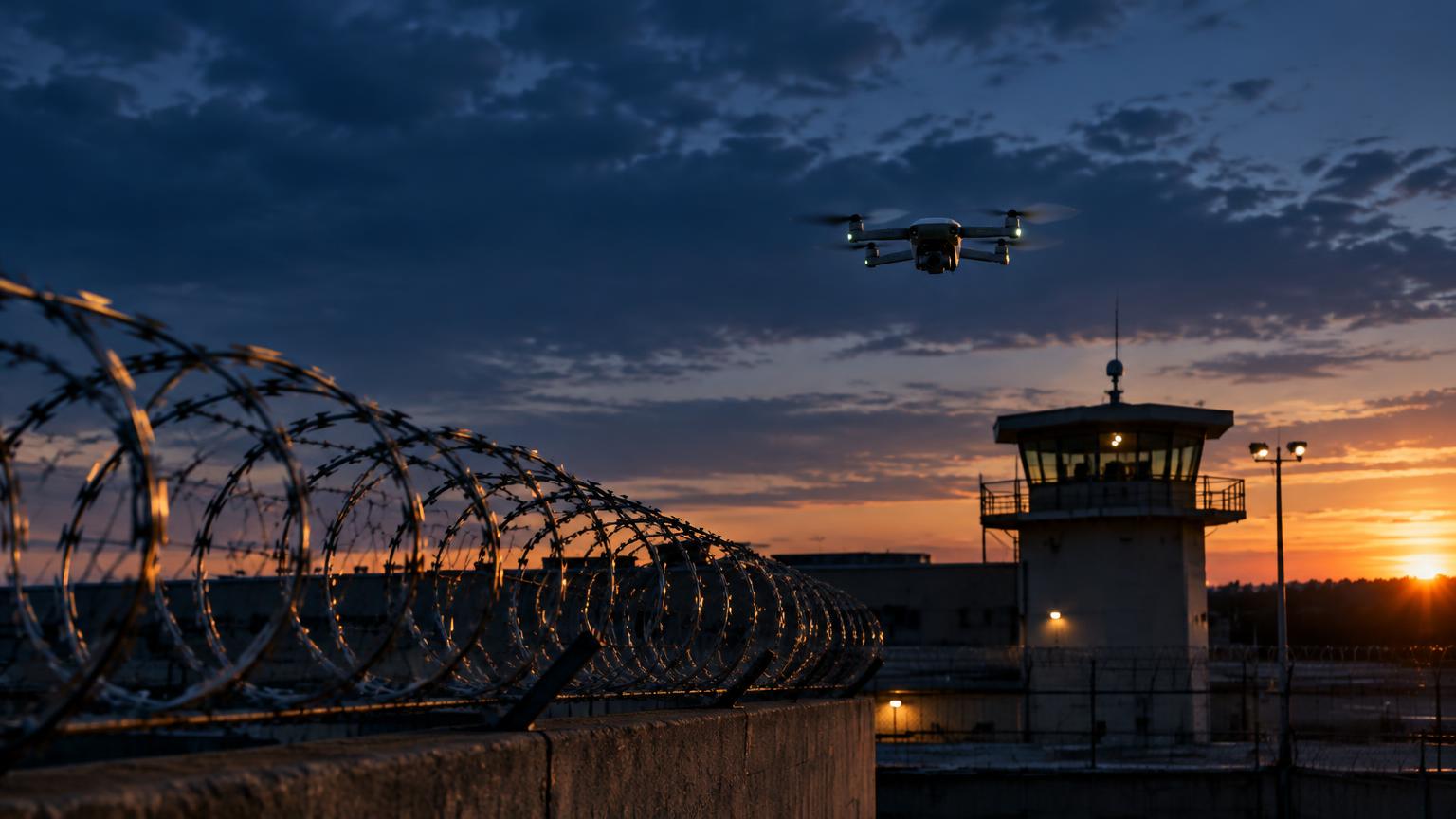
Aerial delivery is now a routine correctional security problem
Federal auditors first recorded a drone incident at a Bureau of Prisons facility in March 2015. By 2019 the agency logged 57 incidents in a single year, and its own inspector general cautioned that reported totals understate the problem.
Capability detail →- 2018~38
- 201957
Capabilities
Security and life-safety capabilities
Our approach is technology-neutral and operationally focused. We help clients identify the right capability and deployment model for each facility rather than attempting to force one solution across every operating environment.
01 / AERIAL
Aerial Awareness and Emergency Response
02 / AIRSPACE
Counter-Drone and Airspace Security
03 / COMMUNICATIONS
Unauthorized Communications Detection and Control
04 / CONTRABAND
Drug and Contraband Detection
05 / SCREENING
Persons, Property, and Cargo Screening
06 / USE OF FORCE
Less-Than-Lethal and Staff-Safety Technology
07 / LIFE SAFETY
Fire, Smoke, and Hazardous-Air Protection
08 / INFRASTRUCTURE
Communications, Video, and Physical-Security Modernization
09 / FORENSICS
Digital Forensics and Evidence Preservation
10 / RESPIRATORY
Respiratory Protection for Staff and Occupants
11 / INVESTIGATIONS
AI Investigative Review
How we work
- DEFINE
- VALIDATE
- DEMONSTRATE
- DEPLOY
Define
We clarify the threat, operational requirement, affected facilities, stakeholders, governing authorities, funding environment, and desired outcome.
Validate
We assess technical suitability, facility conditions, infrastructure, policy, regulation, funding, acquisition strategy, operational readiness, and market viability.
Demonstrate
We develop agency briefings, product demonstrations, pilot programs, test plans, performance measures, and decision-quality reporting.
Deploy
We support procurement, implementation, training, policy development, operational adoption, performance review, and expansion to additional facilities.
Frequently asked questions
- What does Intercept Technologies & Security Consultants do?
- Intercept provides security technology and strategic advisory to federal, state, and local correctional agencies — prisons and jails — and to the technology companies and contractors serving them, with capabilities extending to law enforcement and other industries — moving proven security capabilities from requirement through evaluation, funding, procurement, deployment, and operational adoption.
- Who leads Intercept?
- Todd Craig, Managing Partner, a 35-year Federal Bureau of Prisons veteran who served as Warden, Chief of the Office of Security Technology, and Acting Assistant Director. He holds ASIS Certified Protection Professional credential #17,658.
- Which security areas does Intercept cover?
- Eleven areas: aerial awareness; counter-drone and airspace security; contraband cellular detection and control; drug and contraband detection; persons and cargo screening; less-than-lethal and staff safety; fire and hazardous-air protection; communications, video, and physical-security modernization; digital forensics and evidence preservation; respiratory protection; and AI investigative review.
- What consulting and advisory services does Intercept offer?
- Four services: security assessments; security technology gap analysis and action plans; federal and state procurement advisory support (RFIs, RFPs, IDIQs, sole-source, BPAs, and procurement protests — strategic support, not legal representation); and executive engagement and funding strategy, including budget exhibits, funding justifications, and talking points for DOC leaders.
- Can correctional facilities legally jam drones or cell phones?
- Generally no. Non-federal agencies are prohibited from jamming under the Communications Act, and drone mitigation authority is limited to specific federal agencies under 6 U.S.C. §124n and 10 U.S.C. §130i. Detection, location, managed access, and investigation are the common lawful approaches.
- How do I request a briefing?
- Use the Request a Briefing form at intercepttec.com/contact or call 571-328-1308.